









The Staffroom Blog
Ideas worth sharing. Conversations worth having.
Honest writing on educational technology, classroom practice, and the professional life of a modern educator. No jargon. No pretending it's easier than it is. Just real ideas for educators ready to grow.

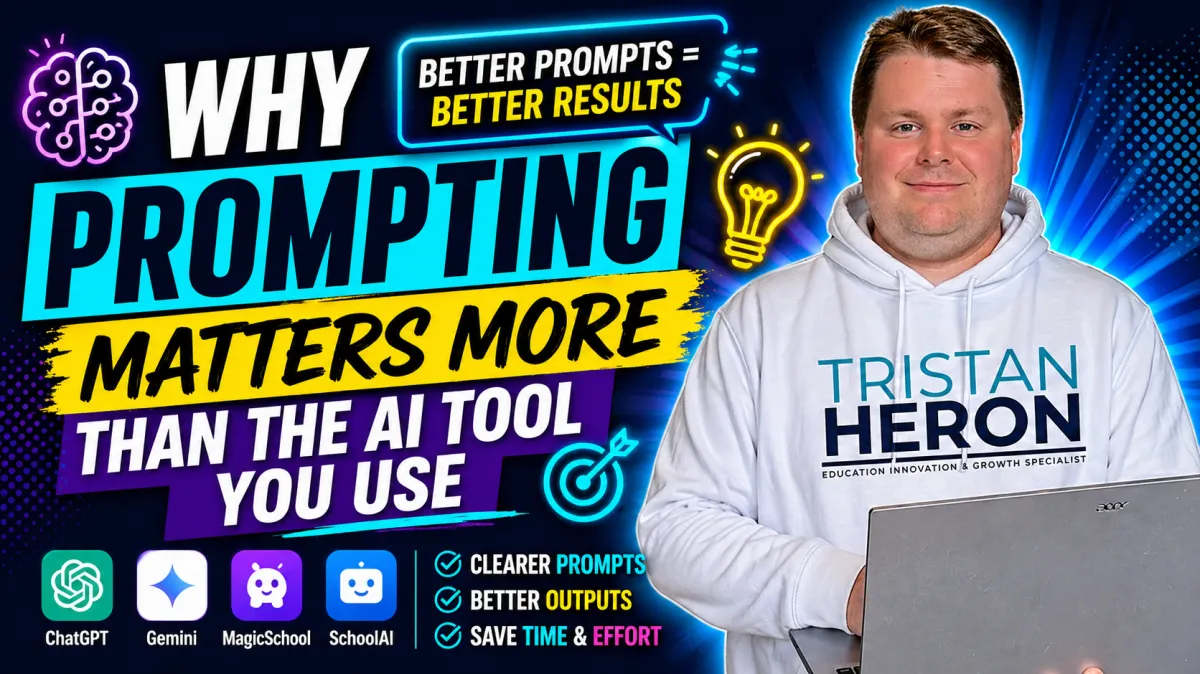
Why Prompting Matters More Than the AI Tool You Use
ChatGPT. Google Gemini. MagicSchool. SchoolAI.
New AI tools continue to appear, each promising to save time, boost productivity and transform education.
But no matter which tool you use, one truth remains the same:
The quality of your output depends heavily on the quality of your prompt.
At Evolve EdTech, we often remind educators that prompting is quickly becoming one of the most valuable modern teaching skills.
Because the tool matters.
But the prompt often matters more.
What Is Prompting?
Prompting is simply giving clear instructions to AI.
In many ways, it is no different from teaching.
If we give vague, rushed or confusing instructions to students, we usually get mixed results.
AI works the same way.
If you type:
Write me a lesson plan.
What exactly should the tool do?
What subject?
What year level?
How long is the lesson?
What curriculum outcomes matter?
What teaching style do you want?
Do you need differentiation?
Is it practical or theory-based?
Without context, the AI is guessing.
And when AI has to guess, results are often generic, shallow or not particularly useful.
What a Stronger Prompt Looks Like
Now compare that with:
You are an experienced Year 6 English teacher. Create a 40-minute lesson plan on persuasive writing, including a group activity and a writing checklist.
Suddenly, the AI has direction.
It knows:
The audience
The year level
The topic
The time frame
The desired outputs
The context
The response is far more relevant and practical.
That is the real power of prompting.
Why Strong Prompting Saves Teachers Time
Many educators become frustrated with AI because they receive weak outputs.
Often, the issue is not the platform.
It is the instruction.
Strong prompts can help teachers:
Generate sharper lesson ideas
Create better resources faster
Receive more relevant examples
Improve planning efficiency
Reduce time editing poor responses
Explore differentiated options
Brainstorm with greater precision
Weak prompts often create extra work because you spend more time fixing what AI misunderstood.
Simple Ways to Improve Your Prompts
You do not need to be a prompt engineer.
Start with clarity.
Include these elements where relevant:
1. Role
Who should the AI act as?
Example: You are an experienced primary teacher…
2. Task
What exactly do you want created?
Example: Create a lesson plan, rubric or quiz.
3. Context
Add year level, subject, unit or audience.
4. Constraints
Set time length, reading level, tone or format.
5. Output Style
Ask for bullet points, tables, checklist format or steps.
The clearer you are, the better the AI can support you.
Prompting Is a Future-Ready Teacher Skill
In the AI era, knowing what to ask can be just as important as knowing what to teach.
Prompting develops habits educators already value:
Clear communication
Intentional planning
Precision thinking
Reflection on outcomes
Efficient workflows
It is less about technology and more about thinking clearly.
Final Thoughts
At Evolve EdTech, we believe AI is not a mind reader.
It is a responsive tool.
The clearer your instructions, the stronger your results.
So before chasing the next shiny AI platform, refine the skill that matters across all of them:
Prompting.
Because better prompts often create better possibilities.

JOIN OUR COMMUNITY
Join thousands of educators in the know.
Get the latest EdTech insights, classroom strategies, free resources, and community updates delivered straight to your inbox. No spam.
By joining the community, you’ll receive practical tips, tools, and ideas to help you grow as an educator, along with updates and opportunities from Tristan Heron.
No spam. Just value. You can unsubscribe at any time, and your details will always be kept safe and secure.



© Copyright 2026 Tristan Heron Education Group. All rights reserved.